Showing posts with label Toyota. Show all posts

2012 Toyota Camry Hybrid

2012 Toyota Camry Hybrid – Toyota Camry Hybrid is equipped with 3.5-liter V6 engine capable of providing 268 horsepower. Machine has got 6-speed automatic with sequential-shift transmission system. Thanks to the 6-speed automatic with sequential-shift transmission facilities, the 2012 Toyota Camry Hybrid churning out great fuel economy – 24 miles per gallon in the city and 33 miles per gallon on the highway. Fuel Capacity 18.5 gal. 2012 Toyota Camry Hybrid is at an interesting point in the series where the producers try to show a new feature to renew interest in this series are dominant in the last decade.

Safety Features available with the 2012 Toyota Camry Hybrid is ABS with Brake Assist and Electronic Brake-force Distribution, twin, dual-stage front airbags, tire pressure monitoring system, driver knee airbag, side-curtain airbags and front seat-mounted side airbags. 012 Toyota Camry Hybrid comes built with a medium four-door sedan that is equipped with front-wheel drive system. It is impressive about the Toyota Camry Hybrid outside this range is that even the standard model is built with hefty amount of features.
2012 Toyota Camry Hybrid

2012 Toyota Camry Hybrid

2012 Toyota Camry Hybrid


2012 Toyota Camry Hybrid is equipped with tilt steering wheel, air stability control, full power accessories, tilt and telescope steering wheel, cruise control, air conditioning units, satellite radio, Bluetooth, and six speaker audio system, 8-way power driver seat, keyless remote entry, power windows, door locks and outside mirrors, AM/FM/CD/MP3, 6-speaker 160-watt stereo, cruise control, power moonroof etc. You also can choose leather seats and heated front seats, 16 – inch alloy wheels, navigation system and moonroof, vehicle stability control with traction control etc. The 2012 Toyota Camry Hybrid is also equipped with a basic warranty of 3 years or 36,000 miles.

2012 Toyota Camry Hybrid can carry up to 15.0 cu. ft. of cargo. It can haul up to 1000 lbs. as well. The car also can accommodate five passengers. 2012 Toyota Camry Hybrid is the highest among all the intermediate four-door sedan is available in the United States. 2012 Toyota Camry Hybrid is loaded with all the equipment you wish to see in the medium four-door sedan.

2013 Toyota iQ EV

2013 Toyota iQ EV - At 3,120 mm overall, the new Toyota iQ EV is just 135 mm longer than a standard iQ, sharing the latter’s overall width of 1,680 mm, height of 1,505 mm and 2,000 mm wheelbase. A minimum turning circle of just 4.1 metres offers excellent urban manoeuvrability.

The new Toyota iQ EV combines compact city car agility with zero emissions and the easy, silent driving style of a fully electric vehicle.


2013 Toyota iQ EV

2013 Toyota iQ EV

2013 Toyota iQ EV

2013 Toyota iQ EV

2013 Toyota iQ EV

2013 Toyota iQ EV

Its small, 4.1 metre turning circle gives it excellent manoeuvrability in the urban environment, and the position of the battery pack beneath the vehicle floor creates a low centre of gravity and ideal front/rear weight distribution for excellent ride comfort and agile, engaging handling.

A further development of Toyota’s Hybrid Synergy Drive® technology, the iQ EV’s fully electric powertrain comprises an air-cooled, 47 kW electric motor/generator, a 150 cell, a 12.0 kWh, 277.5 V battery pack, a 3 kW water-cooled battery charger, an inverter, an DC/DC converter and a motor speed reduction mechanism.

The motor/generator, planetary gear speed reduction mechanism and torque biasing differential are all housed in a new, ultra-compact, EV-exclusive transaxle, which combines a low centre of gravity with reduced energy losses to minimise power consumption.

Maximum torque of 163 Nm is delivered, from a standstill, to the front wheels, giving the Toyota iQ EV 0-100 km/h acceleration of 14.0 seconds and a maximum speed of 125 km/h.

The new Toyota EV generates zero CO2, NOx or particulate emissions throughout its operation. With a power consumption of 134 Wh/km, this equips the vehicle with an NEDC-certified range of 85 km between charges.

Similar to Toyota’s full hybrid vehicles, the iQ EV is equipped with a regenerative braking system. When decelerating with the accelerator pedal released, the rotation of the wheels is transmitted to the motor, which acts as a generator, converting kinetic energy into electricity for storage within the battery.

The iQ EV’s gate-type gear shift lever offers drivers three driving ranges: D-range controls the vehicle to consume the least amount of power during city driving; S-range increases acceleration performance for brisk driving; and B-range maximises regenerative braking to extend the vehicle’s driving range as far as possible.

Via an illuminated battery charger inlet conveniently located beneath a discreet, flush-mounted panel at the front of the new Toyota iQ EV, the battery pack can be fully recharged in approximately 3 hours from a standard, 230 V household outlet.

A dedicated rapid charger compliant port is available as an option, enabling the battery to be 80% recharged in just 15 minutes, greatly enhancing the new Toyota EV’s everyday practicality.

News/Images Source: Toyota

2013 Toyota NASCAR Camry

2013 Toyota NASCAR Camry. The introduction of the new 2013 Camry for NASCAR competition marked the culmination of an aggressive redesign to provide the 2013 Camry with an updated and more-unique identity. TRD worked together with Calty Design, part of Toyota’s global network design team, to create an on-track Camry that incorporates design elements which give America’s best-selling car its distinct character.

A new front grill-area that matches the production model, distinct character lines down the side of the vehicle and an updated rear bumper make the redesigned 2013 Camry stock car more relevant than ever before to its showroom sibling.


In an effort to create more distinct and stock vehicles for the race track, NASCAR worked together with the four series manufacturers to determine what areas were either ‘locked in’ or ‘open’ for unique design. NASCAR also allowed for the exchange of glass for solid body pieces.

The new 2013 Toyota Camry will make its NASCAR Sprint Cup Series debut at Daytona International Speedway’s ‘Speedweeks’ in February.

News/Images Source: Toyota

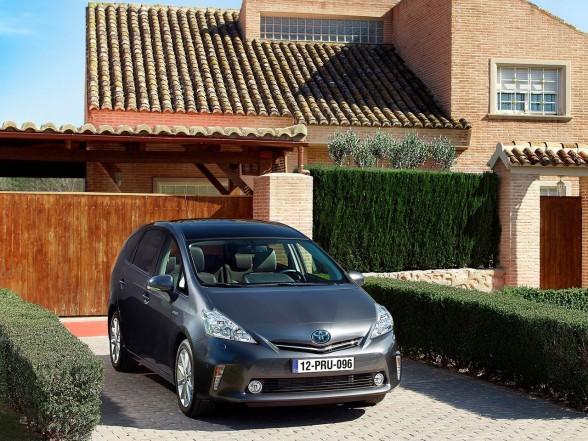
2013 Toyota Prius+

2013 Toyota Prius+. Though still compactly sized to optimise its aerodynamic performance, the Prius+ provides, as its name suggests, a significant increase in space and passenger accommodation. It is 135 mm longer than a standard Prius, 30 mm wider, and 85 mm higher, with a wheelbase extended by 80 mm, making it possible to accommodate 7 people in three rows.

Instantly recognisable as the latest member of the Prius family through its characteristic, triangle silhouette, the new Prius+ combines Toyota’s Under Priority frontal design language with painstaking airflow management to give the new 7-seat full hybrid uniquely clean, advanced and cutting-edge styling.


The front of the new Prius+ features the latest representation of Toyota’s trapezoidal, Under Priority design. Featuring chrome-plated horizontal trim, the upper grille opening has been kept as small as possible to maintain a smooth airflow over the upper body. In contrast, the lower grille has been enlarged to increase engine cooling efficiency.

The presence of Hybrid Synergy Drive® is denoted by hybrid blue lamp ornamentation and Toyota badging, and the front wing ‘Hybrid’ badge. The new Prius+ is available in a range of seven exterior colours, including Toyota’s unique White Pearl finish.

The 16″ alloy wheels with aerodynamic wheel caps and the 17″ aluminium alloys both feature tyres with a 5% lower rolling-resistance than those fitted to the standard Prius.

The lightweight, highly compact, 4-cylinder 1,798 cc Atkinson cycle petrol engine develops 98 DIN hp/73 kW at 5,200 rpm and 142 Nm of torque at 4,000 rpm. Combined with a cooled Exhaust Gas Recirculation system, the adoption of the Atkinson cycle offers significant gains in fuel efficiency and the reduction of emissions.

Because the intake valves close late in an Atkinson Cycle engine, compression is delayed. This creates a high expansion ratio for less compression, reducing intake and exhaust energy losses and converting combustion energy to engine power more effectively. As a result, the exhaust temperature is lower than that of conventional engines. Cooled Exhaust Gas Recirculation reintroduces cooled exhaust gas into the intake system, further reducing engine operating temperatures.

The Prius+’s Hybrid Synergy Drive® powertrain combines the 99 DIN hp/73 kW output of the 1.8 litre petrol engine with the 60 kW output of the electric motor for a maximum system power output of 136 DIN hp. The Prius+ will accelerate seamlessly from 0-100 km/h in 11.3 seconds and has a top speed of 165 km/h.

Its environmental performance enhanced by the Toyota Prius+’s class-leading aerodynamic performance and low weight, the full hybrid drive system returns both class-leading fuel economy and CO2 emissions of 4.1 l/100 km and 96 g/km respectively.

News/Images Source: Toyota

2013 Toyota Yaris Hybrid

2013 Toyota Yaris Hybrid. Combining the ingenious packaging and urban agility of the Yaris model range with the unique driving experience and efficiency of Toyota’s Hybrid Synergy Drive® (HSD), the Toyota Yaris Hybrid is a new major step in the company’s full hybrid European roll-out strategy.

Combining the power of a 55 kW petrol engine and battery powering the electrical motor, the Toyota Yaris Hybrid’s highly efficient powertrain generates a maximum 74 kW/100 DIN hp system output. It offers the best balance of performance and fuel consumption/CO2 emissions in the B segment.


The Toyota Yaris Hybrid will accelerate seamlessly from 0-100 km/h in 11.8 seconds, and on to a maximum speed of 165 km/h. Conversely, it delivers an average fuel consumption of just 3.5 l/100 km and segment-best CO2 emissions of only 79 g/km, whilst allowing customers frequent driving in modes that emit zero NOx, PM or CO2 emissions. Its exceptional fuel efficiency gives the Yaris Hybrid a driving range of 1,000 km on a single tank of fuel.

From start-up and at speeds up to 50 km/h the new Yaris Hybrid automatically operates in EV mode, driving under electric motor power alone. The driver may also select EV mode manually. This unique driving mode is only available to drivers of full hybrid vehicles.

With vehicle range dictated by battery charge, the EV drive mode allows for urban driving with minimal noise and zero CO2, NOx and PM emissions for up to two kilometres. Because the petrol engine is switched off throughout its operation, the EV drive mode contributes to a significant reduction in the Toyota Yaris Hybrid’s overall fuel consumption.

In ECO mode, throttle response to aggressive accelerator pedal inputs is reduced and air-conditioning control optimized for improved fuel economy. Depending on driving conditions, the ECO mode can help drivers achieve about 10% reduction in fuel consumption versus the normal mode.

News/Images Source: Toyota

Toyota Sport Cars GRMN Sports Hybird Concept II


Toyota Sport Cars GRMN Sports Hybird Concept II

The GRMN Sports Hybrid Concept II is the second edition of Toyota's sports hybrid all-wheel-drive MR2 Spyder concept. First unveiled at the Nurburgring 24 Hour race in the summer, Toyota has recently displayed the hybrid sports car concept at both the Tokyo Motor Show and now at the Tokyo Auto Salon, hinting just how serious they are about keeping it in the public’s eye.
Toyota Sport Cars GRMN Sports Hybird Concept II

The GR stands for Gazoo Racing and the MN means it was developed with help from Toyota's renowned test driver Hiromu Naruse, or the "Master of Nurburgring."Toyota Sport Cars GRMN Sports Hybird Concept II.
Toyota Sport Cars GRMN Sports Hybird Concept II

The updated version gets a tweaked front end and a more developed sports-hybrid all-wheel-drive system. The powertrain of  The 2013 Toyota Sport Cars GRMN Sports Hybird Concept II consists of a 3.5-liter V6 engine that sits behind the seats to power the rear wheels and an electric motor that powers the front axle. Output of The Toyota Sport Cars GRMN Sports Hybird Concept II stands at 245 horsepower for the mid-mounted gasoline engine and 295 total hp with the electric motor included. Toyota said the concept will weigh approximately 3,300 pounds.
Toyota Sport Cars GRMN Sports Hybird Concept II

Specification: 2013 Toyota Sport Cars GRMN Sports Hybird Concept II

Engine Type: Petrol V6
Displacement: 3,456 cc
Maximum output 245 bhp
System Maximum output 295 bhp
Body Length: 4,350 mm
Width: 1,890 mm
Height: 1,200 mm
Wheelbase: 2,575 mm
Weight: 1,500 kg or less
Vehicle layout: Mid-engined with front electric motor
Tyres Front: 225/40R19
Tyres Rear: 255/35R19
Toyota Sport Cars GRMN Sports Hybird Concept II

Yaris Works of Young Indonesian Graphic Designers


PT Toyota Astra Motor (TAM) took four young Indonesian graphic designers who want to pour fresh ideas on the body of the Toyota Yaris. Titled "Brightspot Market", Yaris young designer's work was later displayed at Pacific Place, Jakarta.

Top 10 Worst Car Names

We spend a lot of time discussing how a car behaves, how it looks and how it performs in crash tests, among others. Sometimes, however, our first impression of a car comes from his name - and this impression is not always a good idea. Here are 10 cars in 30 years with names so terrible and difficult as we are sometimes surprised consumers gave them a shot. Remember this list is based solely on the name of the car, and has absolutely nothing to do with the actual substance of the car.

10. The Entire Lincoln Lineup
2010 Lincoln MKZ

2010 Lincoln MKZ

Lincoln is a brand with a considerable history, and we know they know how to give cars strong iconic names such as Continental or Navigator. Somewhere around 2007, many of those easy-to-remember names went out the window, leaving consumers with a hodgepodge of names starting with "MK." That's a shame because Lincoln has a strong lineup right now. What's the difference between the MKZ, MKX and MKS? Gimme a second to look it up because I honestly can't remember which is which.

9. Hyundai Equus
2011 Hyundai Equus

2011 Hyundai Equus

The inclusion of the Equus might be premature considering it's not even on sale yet, but this could be the push Hyundai needs to give the car a proper name before it's released. Companies occasionally give Latin names to products to make them sound sophisticated or fancy, but Equus just makes us think of the Broadway play of the same name — most recently starring Daniel Radcliffe of Harry Potter fame — where a young man loves horses a little too much.

8. Toyota Yaris
2010 Toyota Yaris

2010 Toyota Yaris

There was a girl in my dorm freshman year who organized her shoes alphabetically by mood. She majored in dead languages and responded to every single question with "no worries." She once set the dorm microwave on fire by overcooking a ham-and-cheese Hot Pocket. Yes, that story is ridiculous and nonsensical ... sort of like naming a car Yaris.

7. Kia Forte Koup
2010 Kia Forte Koup

2010 Kia Forte Koup

As writers, we're particularly offended when companies take liberties with the English language in an effort to be cutesy — and this is no exception. We actually like this car! But Kia is asking us to overlook years of schooling and experience to accept their quirky spelling of coupe. It might require a few sessions with a therapist before we can get to that happy place.

6. Subaru B9 Tribeca
2006 Subaru B9 Tribeca

2006 Subaru B9 Tribeca

Here we've got a family crossover named after a fashionable neighborhood in lower Manhattan and ... a World War II bomber? Consumers didn't understand the B9 moniker either; that part of the name got the ax when Subaru redesigned the SUV for the 2008 model year.

5. Volkswagen Touareg
2007 Volkswagen Touareg

2007 Volkswagen Touareg

A few Volkswagens could've made this list, but the Touareg was easily the name that tripped up our American mouths the most. Early Touareg commercials in the U.S. even depicted people struggling to say the name. When an automaker has to spend precious time and ad dollars helping consumers learn to pronounce the car's name — something is wrong.

4. Ford Probe
1993 Ford Probe

1993 Ford Probe

There are many borderline inappropriate jokes you could make about a 1990s sport compact named Probe, but we're far too classy for that. Even if you don't take into account the tasteless jokes, this is just a bad car name. There is nothing cool about a probe (the word, not the car). What thesaurus was Ford using where probe was synonymous with sleek and sporty?

3. Subaru Brat
1982 Subaru Brat

1982 Subaru Brat

Although Brat is technically an acronym — it stands for Bi-drive Recreational All-terrain Transporter — it's a particularly unfortunate one. "Brat" is almost never used to describe something positively. A brat is not a calm, confident driver who knows what he wants and how to get it. A brat is busy throwing a hissy fit in the corner because his mom won't let him borrow the car to go buy the new Styx album.

2. Isuzu VehiCROSS
2000 Isuzu VehiCROSS

2000 Isuzu VehiCROSS

Isuzu deserves a little credit for creating an attention-grabbing crossover before it was even a recognized vehicle segment, but the name practically beats consumers over the head with the idea (think SUV plus a cross-training sneaker). Add to that the unnecessary capitalization and the fact that VehiCROSS is a mouthful, and you have one bad name.

1. Ford Aspire
1997 Ford Aspire

1997 Ford Aspire

It's pretty safe to say that many drivers' dream cars fall under the category of sports car or luxury auto; few children hope to one day spend their commuting hours behind the wheel of a 63-horsepower subcompact hatchback. When Ford slapped the Aspire name on the back of this car, they were basically saying: "Yeah, even our car knows you wish you were driving something cooler."

Get paid To Promote at any Location